The short definition
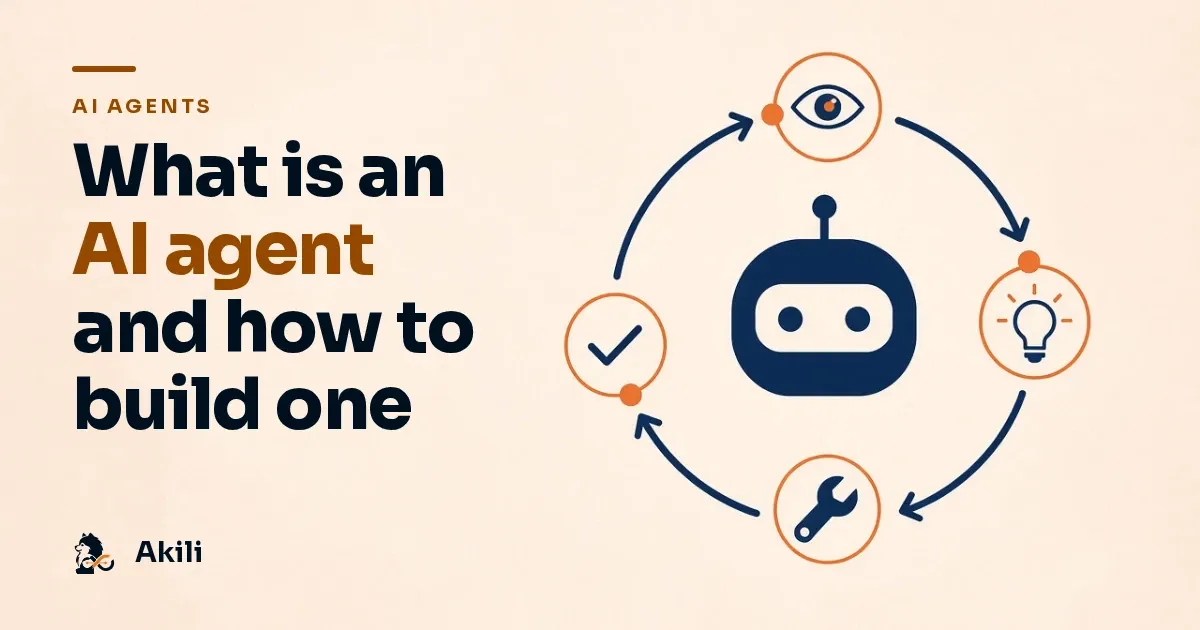
An AI agent is a system that uses a language model to decide which steps to take and which tools to use until it completes a task. It does not just answer: it queries a system, makes a decision, takes an action and checks the result.
Agent, automation workflow and chatbot
In its guide Building effective agents (December 2024), Anthropic proposes a useful distinction:
- Workflows: the language model and the tools follow steps defined in advance in code.
- Agents: the model directs its own process and decides how to use the tools to complete the task.
The same guide recommends starting with the simplest possible solution and adding complexity only when needed. Many business processes are better solved with a workflow than with an agent.
A traditional chatbot, for its part, follows a script of questions and answers. It can use AI to understand the user better, but it does not carry out tasks in your systems.
When an agent makes sense
An agent is justified when the task:
- Has steps that change from case to case.
- Requires querying several sources or systems.
- Needs to interpret unstructured information, such as emails or documents.
If the process always follows the same steps, an automation workflow is usually cheaper, more predictable and easier to maintain. Tools like n8n let you build those workflows and even add AI nodes where needed, according to its documentation.
If the agent has to talk, like a voice agent or a voice-enabled chatbot, a voice platform is added. At Akili we use ElevenLabs for that, and this site’s voice assistant runs on ElevenLabs.
How to build an AI agent in five steps
- Define a bounded task. “Serve customers” is too broad. “Answer order status on WhatsApp and hand complaints to a person” is a good start.
- Decide which tools it can use. Each tool is an action in your systems: look up an order, create a case, send an email. Connect only the ones it needs.
- Write the rules and limits. What it can do on its own, what it must check and when it must hand the case to a person.
- Test it with real cases. Include the hard and ambiguous ones. Review every answer before opening it to customers.
- Put it into production with supervision. Log what it does, measure the results and keep a person reviewing the exceptions.
What to watch
- Personal data. If the agent uses customer information, apply Colombia’s Law 1581 of 2012 (or the data protection law that applies to you): use only the data the task needs.
- Errors. Language models can make mistakes. Design the agent so a person can review and correct.
- Operating costs. Every call to the model has a cost. A poorly designed agent can make more calls than necessary.
Frequently asked questions
Does an AI agent replace an employee?
A well-designed agent takes on a bounded task, with clear rules and limits, and hands a person the cases it should not resolve on its own. Because language models can make mistakes, a person reviews the exceptions and corrects the errors.
What tools are used to build an agent?
An agent combines a language model with tools, which are actions in your systems: look up an order, create a case, send an email. If the process always follows the same steps, an automation workflow is usually enough; tools like n8n let you build them and add AI nodes, according to its documentation. If the agent has to talk, a voice platform is added; at Akili we use ElevenLabs.
How long does it take to build an agent?
It depends on how bounded the task is, how many tools it needs and the testing with real cases, including the hard ones. A well-defined task and few integrations at the start shorten the path. To understand what drives the cost, read how much an AI agent or chatbot costs in Colombia (in Spanish).
Our take
Building an AI agent is more a design job than a programming one: choosing the task well, setting clear limits and testing with real cases. At Akili we build AI agents for companies with that approach and with the specification written before the code. If you have a process in mind, book your free assessment or see how we work in custom software.
Sources
Data and quotes in this analysis, linked to the original source.
- Building effective agents · Anthropic, Dec 19, 2024
- Integrate AI (n8n documentation) · n8n, Oct 25, 2026
Related service
AI agents and custom software
If this topic applies to your company, this is the Akili service that covers it.
See the service
About the author
CTO and Co-founder of Akili
Leads architecture, software and AI delivery at Akili.
More on AI agents
What Amazon Bedrock AgentCore is and when to use it
What Amazon Bedrock AgentCore is, what Runtime, Gateway and Memory are for, how it works with LangGraph and when it beats n8n. A guide for companies.
Juan Carlos Cadavid RuizRead the analysisUber brings an AI agent to more than 30,000 employees: what to learn
Uber went from a 1,000-person pilot to rolling out ChatGPT Work across the company. What it did before scaling and what other companies can replicate.
Juan Carlos Cadavid RuizRead the analysis

This analysis follows our editorial policy.