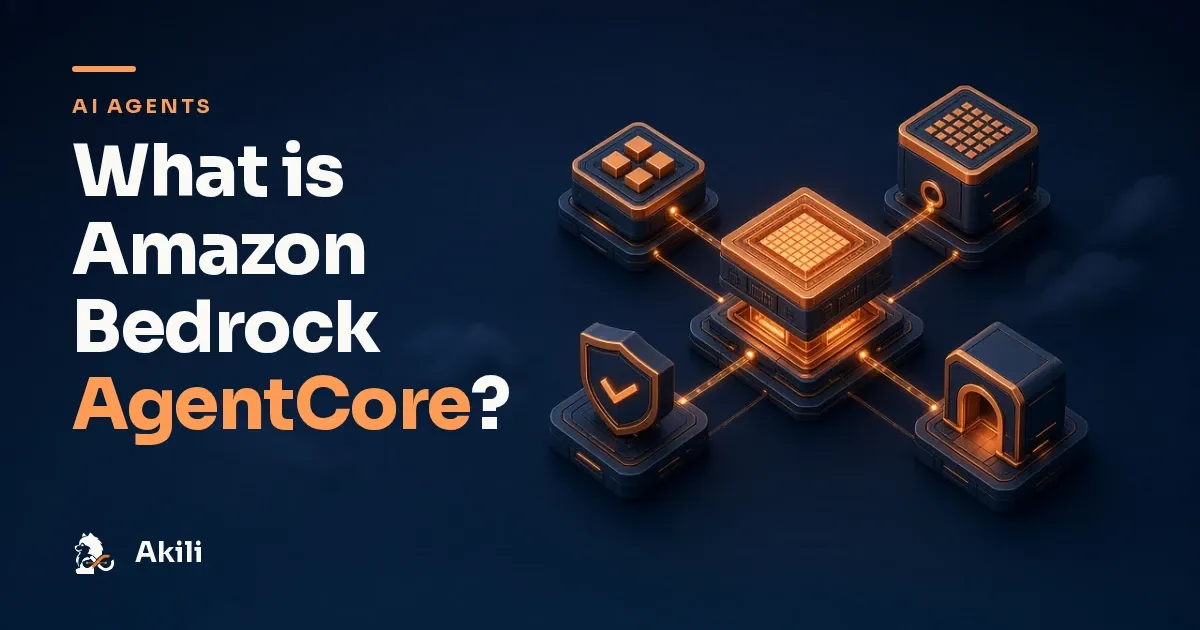
Amazon Bedrock AgentCore is AWS’s platform for deploying and operating AI agents in production without managing servers. It brings together services used together or separately, such as Runtime, Gateway, Memory, Identity and Observability, and works with any framework, such as LangGraph, and with models inside or outside Amazon Bedrock.
From prototype to production: the problem AgentCore solves
An agent prototype fits in a Python notebook. Putting it into production is another matter: you have to host it, give it memory across conversations, connect it to the company’s systems, control on whose behalf it acts and see what it did at each step. AWS presents AgentCore as that production layer: you write the agent in the framework you prefer and deploy it to AgentCore’s managed environment, without managing infrastructure.
AgentCore services in one table
AgentCore is modular: you can use only the services you need. This table summarizes the main ones and whether they are available in the São Paulo Region (sa-east-1), AWS’s Region in South America, according to the AWS Regions table checked on November 4, 2026.
| Service | What it solves | In São Paulo? |
|---|---|---|
| Runtime | Runs the agent in isolated sessions, with long tasks of up to eight hours | Yes |
| Memory | Stores short- and long-term context across conversations | Yes |
| Gateway | Turns APIs and functions into tools the agent can use | Yes |
| Identity | Controls on whose behalf the agent acts, with your identity provider | Yes |
| Code Interpreter | Runs code generated by the agent in an isolated environment | Yes |
| Browser | Lets the agent use web applications | Yes |
| Observability | Traces and dashboards in Amazon CloudWatch | Yes |
| Policy | Rules evaluated before every tool call | Yes |
| Evaluations | Measures the agent’s quality in production and in testing | Yes |
AWS also lists newer services: Harness, Optimization, Registry and Payments. Harness and Optimization are in São Paulo; Registry and Payments, for now, are only in other Regions such as N. Virginia.
Gateway: your APIs and Lambda functions as MCP tools
For many companies, Gateway is the most useful piece. It takes what already exists and exposes it as MCP-compatible tools (Model Context Protocol), the protocol agents use to discover and call tools:
- APIs with an OpenAPI specification or Smithy models, and AWS Lambda functions.
- MCP servers you already have, which it connects to directly.
- Inbound and outbound authentication: who can call the Gateway and with which credentials the Gateway calls your systems.
- Semantic tool search, so the agent finds the right one when there are many.
- Integrations with business tools such as Salesforce, Slack, Jira, Asana and Zendesk.
In practice, instead of coding an integration for each agent, you connect your CRM or ERP once and any authorized agent can use it.
AgentCore + LangGraph/LangChain: not a framework, but where your agent runs
AgentCore does not replace LangGraph or LangChain. LangGraph and LangChain define how the agent reasons and acts: which steps it follows, how the agent hierarchy is organized (a lead or supervisor agent splits the work and, depending on the work, adds several implementer agents and several reviewer agents, each specialized) and which tools it calls. AgentCore runs it, gives it memory, connects it to tools and lets you monitor it.
The conceptual flow is this:
- You write the agent in LangGraph, with the language model of your choice in Amazon Bedrock.
- You package it and deploy it to AgentCore Runtime, which creates an isolated session per conversation.
- You give it access to tools through Gateway and context through Memory.
- You follow each run with Observability.
AgentCore Runtime also works with CrewAI, LlamaIndex, Google ADK, OpenAI Agents SDK, Strands Agents and custom frameworks, and supports models inside or outside Bedrock.
AgentCore vs Amazon Bedrock Agents vs n8n: when to use each
| AgentCore | Amazon Bedrock Agents | n8n | |
|---|---|---|---|
| What it is | Platform to deploy and operate agents built in any framework | Amazon Bedrock feature to configure managed agents | Automation workflow tool with AI nodes |
| When it fits | Agents that reason over several steps, with enterprise-grade memory, permissions and traceability | Agents configured inside Bedrock without choosing a framework | Clear, stable processes with steps you can draw in advance |
| Control over the code | Full: your framework, your logic | Less: Bedrock orchestrates the logic | Visual, node-based |
They often coexist: n8n moves data between systems and the agent makes the decisions.
For voice agents, at Akili we add ElevenLabs, the platform behind this site’s voice assistant.
Security and governance
- Per-session isolation. Runtime runs each session in a dedicated microVM, with its own CPU, memory and file system. When the session ends, the microVM is destroyed and the memory is sanitized.
- Private networking. The services support VPC and AWS PrivateLink.
- Identity. Identity works with existing providers such as Amazon Cognito, Okta, Microsoft Entra ID and Auth0, and stores tokens in a secure vault.
- Rules outside the code. Policy lets you write rules in natural language that are converted to Cedar and attached to a Gateway. Every agent call to a tool is evaluated before it is allowed or denied.
One important limit: AgentCore does not map sessions to users. Your backend does that. Security is a shared responsibility: AgentCore provides the isolation and the controls, and the design of the agent and its permissions is still yours.
Quality in production: Observability and Evaluations
An agent is not deterministic: the same question can produce different paths. That is why you need to see what it did:
- Observability shows traces and dashboards in Amazon CloudWatch and integrates with tools such as Datadog, Dynatrace, LangSmith and Langfuse.
- Evaluations measures the agent’s quality online, on production traffic, and on demand, for example inside your continuous integration process. It comes with built-in evaluators and supports custom ones.
Availability in Latin America
According to the AWS Regions table, checked on November 4, 2026:
- São Paulo (
sa-east-1) has Harness, Runtime, Memory, Gateway, Identity, the built-in tools, Observability, Policy, Evaluations and Optimization. It does not have Runtime Instances, Payments, Agent Registry or Web Search. - N. Virginia (
us-east-1) has all the services. - Mexico (
mx-central-1): AgentCore does not appear in the AWS Regions table. Amazon Bedrock is available there, according to the Bedrock availability by endpoints table.
AWS expands Regions often: in 2026 it added, among others, Bangkok, Malaysia, Milan and Spain (July) and N. California and Hyderabad (August). Check the Regions table before deciding.
How it is billed (no figures)
- Pay as you go, modular and per service, with no upfront commitments or minimums.
- Runtime bills per second based on the CPU and memory used.
- Gateway bills per operation.
- Identity has no additional cost when used through Runtime or Gateway.
- Observability is billed as Amazon CloudWatch.
- The language model is billed separately, in Amazon Bedrock, by tokens.
To estimate your case, use the AgentCore pricing page and the AWS calculator. To understand the total cost of an agent, not just the cloud, read how much an AI agent or chatbot costs in Colombia (in Spanish).
When NOT to use AgentCore
- Deterministic workflows. If the process always follows the same steps, an n8n workflow is faster to set up and easier to maintain.
- A single prompt with no tools. If one call to the model is enough, you do not need an agent platform.
- Teams without an AWS account or governance. AgentCore lives in AWS: without an account, permissions and defined owners, that is the first step, not the agent.
Frequently asked questions
What is Amazon Bedrock AgentCore?
It is AWS’s platform for deploying and operating AI agents in production without managing servers. It is made up of services used together or separately: Runtime to run the agent, Gateway to connect it to tools, Memory, Identity and Observability, among others. It works with any framework and with models inside or outside Amazon Bedrock.
Does AgentCore replace LangGraph or LangChain?
No. LangGraph and LangChain define how the agent reasons and acts. AgentCore runs it, gives it memory, connects it to tools and lets you monitor it in production. That is why we combine them: we write the agent in LangGraph and deploy it to AgentCore.
When does n8n fit and when does an agent on AgentCore?
n8n fits when the process is clear and stable, with steps you can draw in advance. An agent on AgentCore fits when the task requires reasoning over several steps, deciding which tool to use, remembering context or working with enterprise-grade permissions and traceability. They often coexist: n8n moves the data and the agent makes the decisions.
Is AgentCore the same as Bedrock Agents?
No. Amazon Bedrock Agents is a Bedrock feature for configuring managed agents. AgentCore is a broader platform for deploying and operating agents built in any framework, with separate services for execution, tools, memory, identity and observability.
Where is AgentCore available and how is it billed?
AgentCore is available in several AWS Regions, including São Paulo and N. Virginia. Billing is pay as you go and per service, with no upfront payments or minimums, and model usage is billed separately.
Our take
AgentCore does not decide for you which agent to build: it solves where and how it runs securely. At Akili we write agents in LangGraph and LangChain, deploy them to Amazon Bedrock AgentCore and use n8n for simple workflows. If you have a process in mind, book your free assessment or see how we build AI agents for companies.
Sources
Data and quotes in this analysis, linked to the original source.
- What is Amazon Bedrock AgentCore? · AWS (documentation), Oct 25, 2026
- Amazon Bedrock AgentCore is now generally available · AWS What's New, Oct 13, 2025
- Amazon Bedrock AgentCore Gateway (developer guide) · AWS (documentation), Oct 25, 2026
- AgentCore Runtime sessions · AWS (documentation), Oct 25, 2026
- AgentCore Runtime security best practices · AWS (documentation), Oct 25, 2026
- Policy in Amazon Bedrock AgentCore is now generally available · AWS What's New, Mar 3, 2026
- AgentCore Evaluations is now generally available · AWS What's New, Mar 31, 2026
- Supported AWS Regions (Amazon Bedrock AgentCore) · AWS (documentation), Nov 4, 2026
- Amazon Bedrock AgentCore expands to four additional Regions · AWS What's New, Jul 1, 2026
- Amazon Bedrock AgentCore expands to two new Regions · AWS What's New, Aug 27, 2026
- Amazon Bedrock AgentCore pricing · AWS, Oct 25, 2026
- Build AI agents on AWS · AWS, Oct 25, 2026
- Amazon Bedrock Agents · AWS, Oct 25, 2026
- Make agents a reality with Amazon Bedrock AgentCore: Now generally available · AWS Machine Learning Blog, Oct 13, 2025
- Introducing Amazon Bedrock AgentCore Gateway · AWS Machine Learning Blog, Aug 15, 2025
- Integrate AI (n8n documentation) · n8n, Oct 25, 2026
- Regional availability by endpoints (Amazon Bedrock) · AWS (documentation), Oct 25, 2026
Related service
AI agents and custom software
If this topic applies to your company, this is the Akili service that covers it.
See the service
About the author
CTO and Co-founder of Akili
Leads architecture, software and AI delivery at Akili.
More on AI agents
What an AI agent is and how to build one for your company
What an AI agent is, how it differs from a chatbot and from an automation workflow, and the steps to build one for your company without losing control.
Juan Carlos Cadavid RuizRead the analysisUber brings an AI agent to more than 30,000 employees: what to learn
Uber went from a 1,000-person pilot to rolling out ChatGPT Work across the company. What it did before scaling and what other companies can replicate.
Juan Carlos Cadavid RuizRead the analysis
This analysis follows our editorial policy.